Money arrives in two ways, and Insight treats them as the same kind of record: a payment is money you received, and allocating it is saying what it paid for.
Those are two separate steps on purpose. Recording the money is bookkeeping and can happen the moment it lands. Deciding what it settles is a judgement, and doing it carelessly is how a client gets chased for a session an insurer already paid.
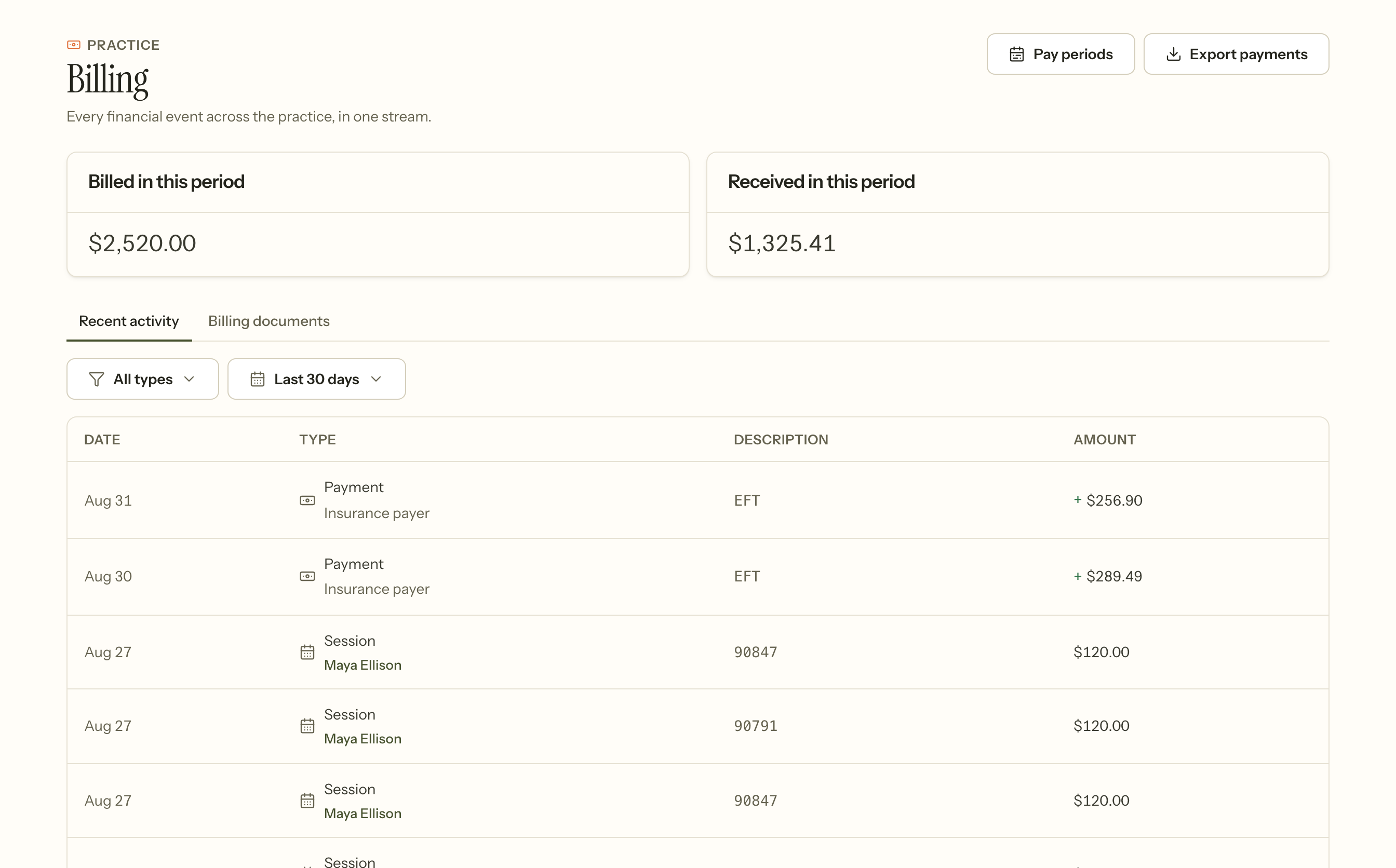
Recording the payment
Insurance › Payments › Record payment.
Source is the whole shape of the record. Insurance means a payer sent it, and you pick the payer. Client means the person paid you, and you pick the client. Everything downstream — what it can be applied to, which reports count it — follows from this one field.
Amount is what actually arrived, not what you expected. If a payer sent less than you billed, record what they sent; the difference is something the next step explains rather than something you round away here.
Received is the date the money landed. It is the date pay periods are measured against, so a payment dated into the wrong period pays somebody the wrong amount. See Billing and payroll.
Method and Reference are for finding it again — the EFT trace number, the cheque number, the last four digits. Both optional, both worth filling in the day a payer says they paid you and you need to prove they did not.
A payment saves as unallocated. That is a real state, not an unfinished one: the money is yours and is counted, but nothing has been told what it settles.
Allocating it
Allocate, on the payment's row.
The drawer lists service lines, not claims, and that is the part worth understanding.
A remittance is issued per service. One payment of $340 might cover six sessions across two clients, and each of those sessions was adjudicated separately — different allowed amounts, different adjustments, different amounts left for the client. Posting $340 against a claim records a number nobody can reconcile against the EOB, and makes "what does this client still owe for the 3rd of March" unanswerable.
Each line is pre-filled with what it still has outstanding, because the ordinary case is that the payer paid what was billed. Overtype the lines that differ. That is the entire job.
The three numbers on a line
Amount is what the payer paid for that service.
Adjustment is what they contractually wrote off — the gap between your fee and what they have agreed the service is worth. It is not a discount you chose and not a loss; it is the price of being in that network.
Client owes is what is left once both are accounted for. It is calculated as you type, and it is the number that turns posting a payment into knowing what to bill next.
What happens to the claim
The claim's totals are rolled up from its lines, and it closes when the payer is finished with it.
A claim is settled at the allowed amount, not the billed one. A payer that allows $120 of a $180 fee pays $120 and writes off $60, and owes you nothing further. That is the ordinary outcome of an ordinary claim, not an edge case — which is why a claim can move to Paid while showing less than you billed.
Partial payments
If the money does not cover everything, reduce the lines it does cover and leave the rest alone. The payment stays partly unallocated, and the lines you did not touch stay open for the next remittance.
Insight will refuse to post lines that add up to more than the payment, and it will say so rather than quietly accepting them. That refusal exists because clinician pay is calculated from allocated amounts: money invented at this screen becomes an overpayment in a pay period, and a closed pay period cannot be edited.
When it goes wrong
The allocation drawer is empty. Nothing is waiting for that payer's money. Either the claims have already been settled, or they have not reached a status that can receive a payment yet — a claim still in Submitted has not been ruled on. Check the payer on the payment matches the payer on the claims.
The payment will not fully allocate. The lines you ticked come to less than the amount received. Either there is a service line you have not applied it to, or the payer sent more than you billed — which is a credit to reconcile deliberately rather than something to force onto a line.
It refused to save. The lines come to more than the payment. Reduce them to what actually arrived.
A claim says Paid but for less than you billed. That is the allowed amount doing its job. The difference was a contractual adjustment, and nobody owes it.
A client is being chased for something insurance covered. Check the Client owes figure on the lines for that session. If it is wrong, the adjustment was recorded wrong — re-post it against the EOB.
Related
- Billing and payroll — charges, pay periods, and paying associates
- Client portal — what a client sees about what they owe