Charges and payments
A session generates a charge. A payment is money that arrived, and it is allocated against charges to say what it settles.
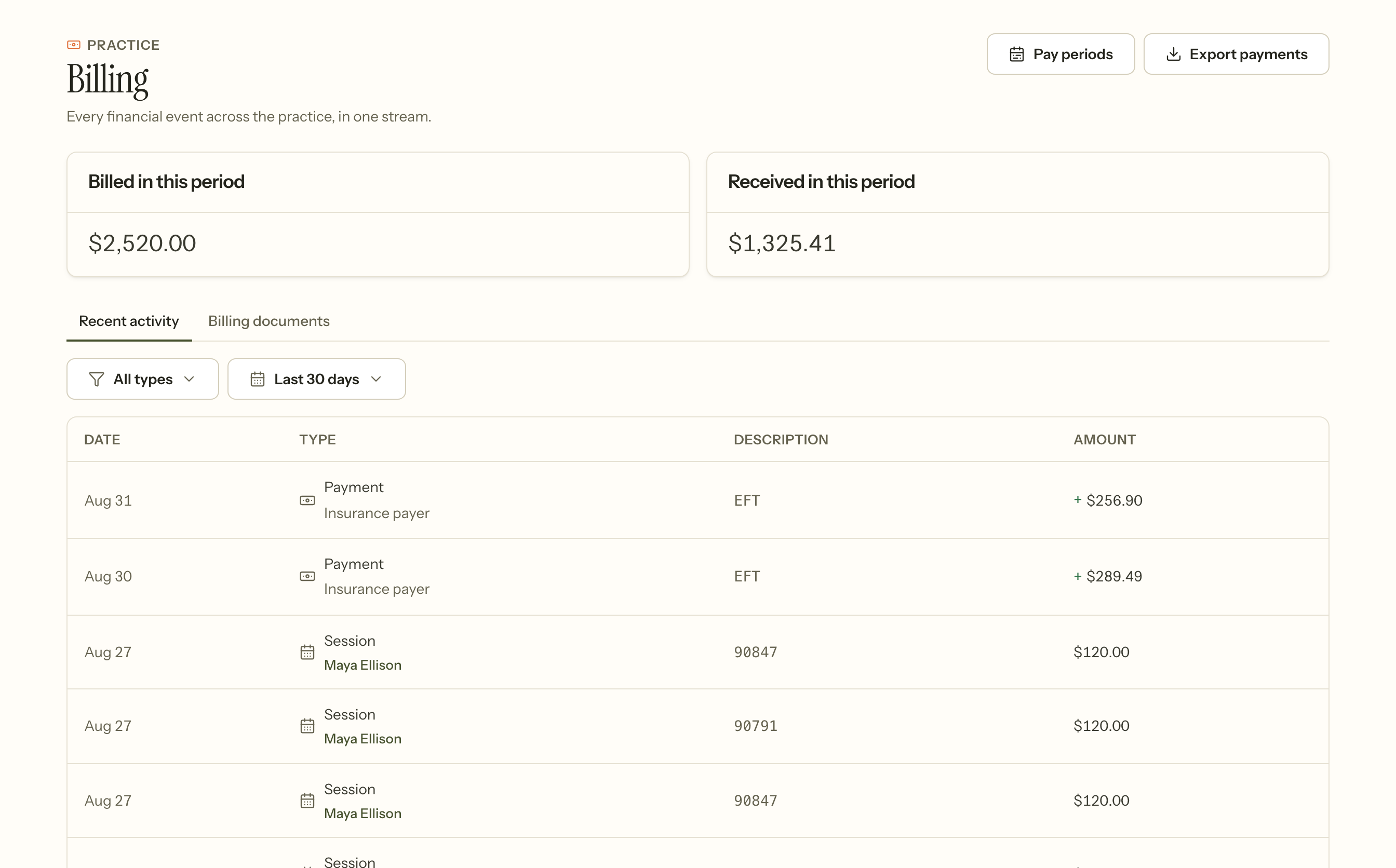
Both appear in one stream on purpose. A session is money owed the moment it happens; a payment is money that arrived. Reading them apart is how a practice ends up chasing somebody an insurer already paid for.
Allocation matters more than it sounds. An unallocated payment is money you have received but have not yet decided what it pays for, and several reports deliberately ignore it rather than guess. Taking a payment is the step-by-step.
Invoices and statements
Billing documents — invoices, statements, superbills — are generated from a client's chart and appear in the client portal if they have one.
Insight does not take payments online. It tells a client what they owe and where to pay; it does not process cards.
Insurance
Claims, payers and remittances live under Insurance. A claim is built from charges, filed, and then followed through its lifecycle until it is paid or written off.
Washington L&I is supported as a first-class payer rather than an afterthought.
Pay periods and paying associates
If you pay clinicians a share of what they collect, Billing → Pay periods is where that is settled.
Open a period for the range you pay over. While it is open the figures are live — they move as payments arrive. The screen says so, because a live figure that looks like a settled one is how somebody gets paid the wrong amount.
Closing the period fixes the figures. That is the moment they become what you pay against. A late payment landing against an old session afterwards does not change a closed period, and neither does renegotiating somebody's share — the rate that applied at the time is part of the record.
Two things worth knowing:
- Collected means money that arrived in the window, not work billed in it. Payroll is funded by what came in; billing that has not been paid cannot pay anybody.
- Periods cannot overlap. Money received on a day that fell in two of them would be paid out twice.
Only the Owner can close or reopen a period. Reopening discards the figures it was closed with, so it is deliberately harder than closing.
When it goes wrong
A payment is not showing in anybody's pay. It is unallocated. Until a payment says which sessions it settles, there is no clinician to attribute it to — see Taking a payment.
The figures moved between yesterday and today. The period is still open, and open periods are live. Closing is what fixes them.
A payment arrived after the period closed. It stays out of that period, on purpose. A closed period is what you paid against; it belongs in the next one.
Somebody's share looks wrong. The rate that applied at the time is part of the record, so renegotiating a share does not reach back into closed periods.
A period will not open. Periods cannot overlap. Money received on a day that fell in two of them would be paid out twice.
Collected is lower than what you billed. Those are different questions. Payroll is funded by what came in, and billing that has not been paid cannot pay anybody.
Related
- Taking a payment — recording money and allocating it
- Clients — the ledger on a client's chart
- Client portal — what a client sees about what they owe