Work through this in order and you will have done everything a billing role does here — from what a session is worth to what a payer eventually paid for it.
What you can reach
Clients, billing, insurance, reports and analytics.
You will not see the calendar or anybody's clinical notes. That is deliberate rather than an oversight: billing needs demographics, coverage and what was done, not what was said. If you need something a screen will not show you, it is a role conversation rather than a missing setting. Roles and permissions has the whole matrix.
1. Everything that moved, in one place
Billing opens on the practice's financial stream: what was billed this period, what was received, and every event behind both.
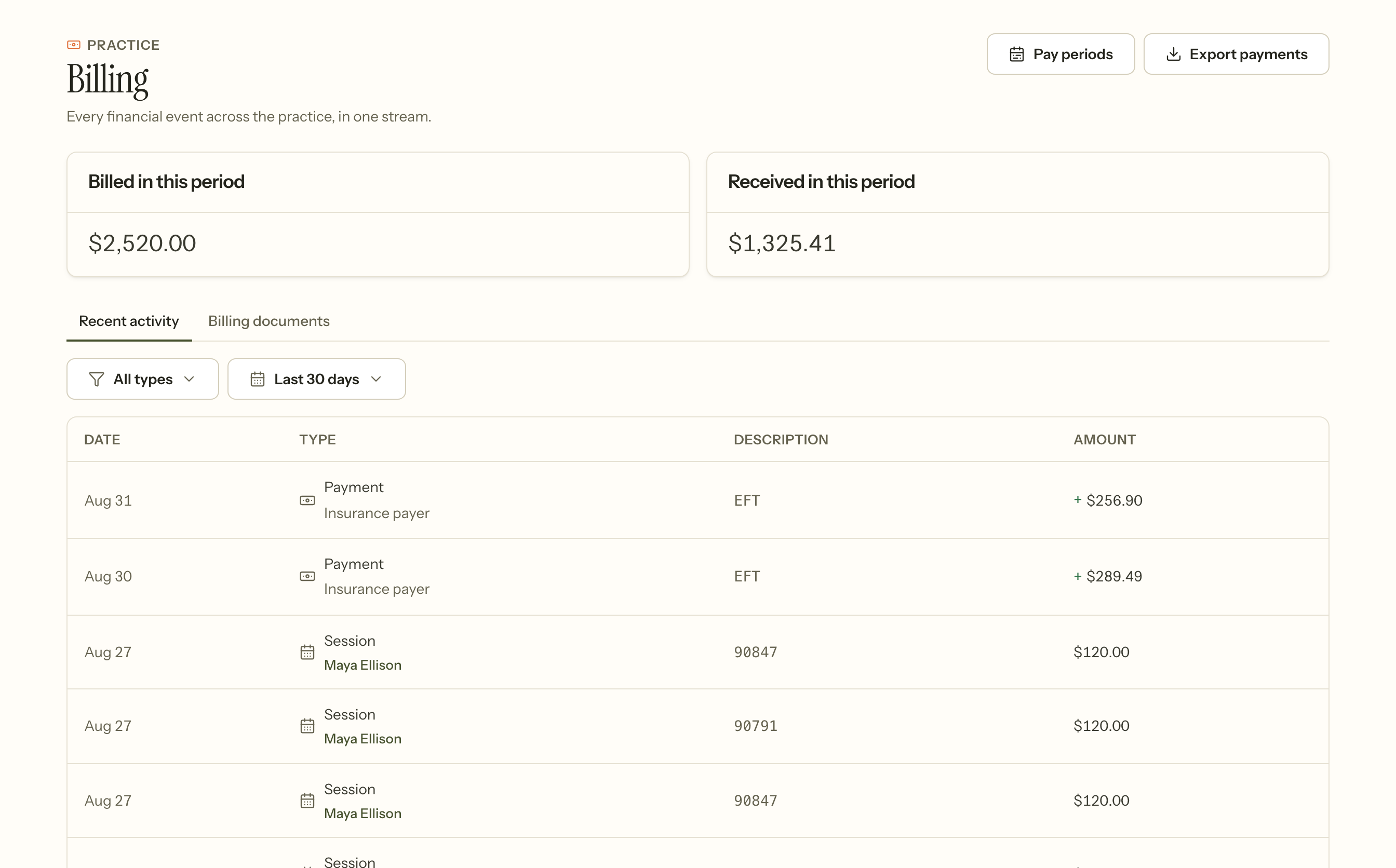
Sessions and payments sit in the same list on purpose. A session is money owed the moment it happens; a payment is money that arrived. Reading them apart is how a practice ends up chasing somebody an insurer already paid for.
2. What one session is worth
Open a client and their ledger shows each session with its fee and what the client themselves owes. Those are different numbers, and the second is the only one a client should ever be shown.
The fee is what the session costs. Between the two sit the payer's contractual adjustment, the insurer's share, the client's copay or coinsurance, and any write-off. Billing and payroll walks the arithmetic.
3. Raising a document
Invoices, statements and superbills are all built from the same charges, so they cannot disagree about what a session cost.
A superbill is the one a client hands their own insurer. Note what it never carries: a product sale. A workbook is not a claimable service, and putting one on a superbill would be asking a payer to reimburse a book.
4. Recording money
Recording a payment and saying what it settles are two steps, deliberately. Money arriving is bookkeeping and can be done the moment it lands. Deciding what it pays for is a judgement, and doing it carelessly is how somebody gets chased for a session that was already covered.
A payment saves as unallocated, which is a real state and not an unfinished one — the money is yours and counted, it simply has not been told what it settles yet.
Taking a payment is the step-by-step.
Insight does not take payments. It records money that arrived through whatever means your practice already uses. There is no card processing here and the client portal has no pay button.
5. When money goes back
A refund is recorded as its own event, not as a negative payment. That sounds like bookkeeping pedantry and is not: every total in the product is written on the basis that a payment means money arrived. Netting a refund off one would quietly change what "received" means in every report that uses the word.
A refund is also refused against money already applied to a session, rather than silently unwinding the allocation behind your back.
6. Claims
Insurance is where a claim's whole life happens — from a session nobody has billed yet to a payer's decision.
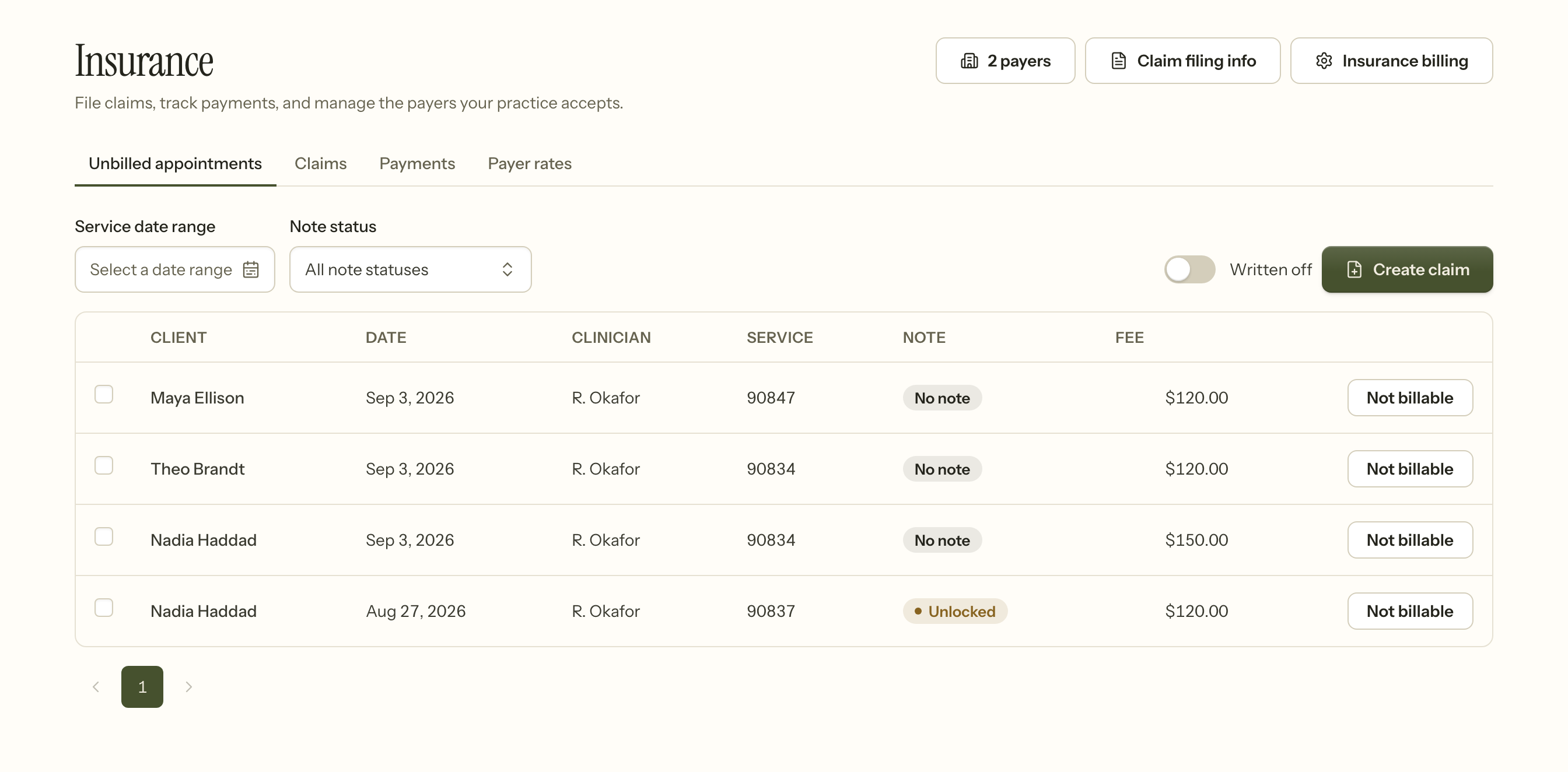
The tabs follow the order the work happens in: unbilled appointments, then claims, then payments, then payer rates.
Note the note status column. A session with no signed note can be seen, but documentation and billing are joined for a reason — billing for a session with nothing in the chart is the thing an audit asks about first.
7. Fourteen answers to "where is that claim?"
A claim carries a real state rather than a vague one, and the two that matter most look alike and are not:
- A rejection never reached adjudication. Something was wrong with the file — a subscriber id, a missing segment. You correct it and send it again.
- A denial was adjudicated and refused. Correcting and resending achieves nothing; this needs an appeal.
Three more — needs scrubbing, info required, applied to deductible — are not failures at all. They are a claim waiting on a person, and they are coloured apart from the red ones because your day is spent on that difference.
8. Washington L&I
L&I gets a real 837P, built to the department's own companion guide. You download the file and upload it yourself through the route they provide. There is no clearinghouse in between and no per-claim fee.
The claim number rides in the subscriber loop, because for L&I the injured worker is the subscriber. REF*Y4 — where you might expect the claim number — is deliberately not sent, because the guide says the department does not expect it.
9. Paying people
Pay periods turn a stretch of the calendar into what each clinician was owed.
Closing a period writes those figures down once. They are not recomputed afterwards — not when a late insurance payment lands against a session from two months ago, and not when a split is renegotiated. The share that applied at the time is copied onto the record, so a rate change in October cannot restate what somebody was paid in August.
Reopening a closed period is its own deliberate act, which is the right shape for something that changes what a person was told they had earned.
10. What you cannot do, and why
- Read a progress note. Billing needs what was done, not what was said.
- See the calendar. Sessions reach you as charges, which is the form billing needs them in.
- Put a product sale on a claim. Structurally impossible, not merely discouraged.
- Bill a session for the demo client. The claim builder refuses outright: a demo client is an invented person, and billing an insurer for sessions with one would be a false claim.
Restricted-access clients are a different matter and can be billed. Restriction governs who may open a chart, not whether the practice may invoice for the work — they are held out of bulk exports and client-naming reports, not out of the money.